Fishing · Techniques & Trends
Late-Fall Bass: Fish the Falling Water Temperature
How falling water temperature moves baitfish and bass in late fall, with a lure for each temperature stage, sonar tips, examples from four continents, and cold-water safety.
In late fall, bait moves by the week and a cold front can reset the bite overnight. Reservoirs, natural lakes, grass lakes, and deep clear lakes all react to the same thing: falling water temperature. Largemouth, smallmouth, spotted, and Alabama bass all respond to changing forage, though their preferred habitats differ.
This guide follows that drop through its stages and matches lures to each one. In temperate Northern Hemisphere regions, this can mean November into early December, or earlier farther north. In the Southern Hemisphere, look for the comparable late-autumn-to-early-winter transition around May to June. Local climate controls the timing. Examples come from the U.S. Southeast, Canada, Japan, South Africa, Spain, and Mexico.
Late-Fall Bass in 30 Seconds: The Temperature Ladder
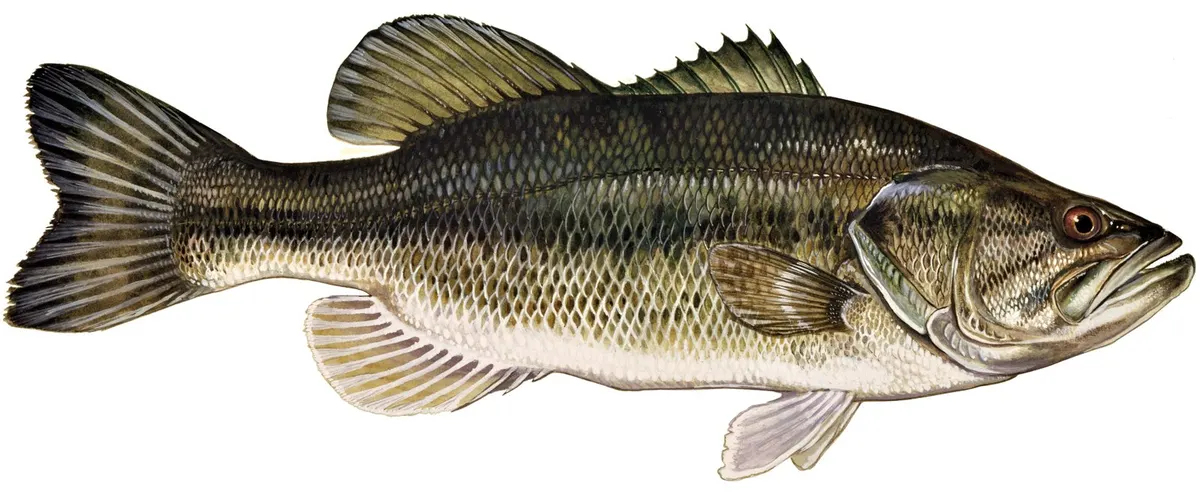
Video by Sportsman Labs Clip Studio, made from this article. Largemouth bass illustration by Duane Raver, U.S. Fish and Wildlife Service (public domain). Music: an original pad generated for this clip; no licensed music and no voiceover. Every on-screen claim comes from this article; see its numbered Sources list (24 sources, checked Nov. 20, 2026).
Transcript
- Late fall bass: a cold front can reset the bite overnight.
- Turnover: lakes feel "off" when the water hits the low 60s and upper 50s. Many mix top to bottom. It often lasts a week or two.
- Find the bait first: "If you find the dinner, you find the diners." (Alex Davis, on Alabama's Smith Lake). Leave any area where sonar shows no bait.
- A lure for each stage. Above 60°F: walking topwater. 55–60°F: lipless crank or bladed jig. 50–55°F: jerkbait or swimbait. Below 50°F: slow jig or spoon. Rough guides only.
- The late window: some of the year's largest bass come as the water falls into the low 50s and upper 40s.
- Full guide at sportsmanlabs.com. Every claim in the guide is sourced.
Captions are timed to the on-screen text. The clip has music and no voiceover.
At a glance: the late-fall temperature ladder
Water temp What bass and bait tend to do Start with Above ~60 °F (16 °C) Schooling, surface feeding on wind and cloud Walking topwater, soft jerkbait, buzzbait ~55–60 °F (13–16 °C) Bait groups up; turnover often hits Lipless crankbait, spinnerbait, bladed jig ~50–55 °F (10–13 °C) Fish chase less after fronts; some suspend Jerkbait, swimbait on a jighead Below ~50 °F (10 °C) Slower, deeper, groups near hard cover; big-fish window Slow jig, deeper swimbait, spoon Rough guides only. Local forage, clarity and species shift every line. Sources below.
Turnover: why a lake feels "off" for a week or two
Many deep lakes stratify in summer. Shiga Prefecture's Lake Biwa Environmental Research Institute in Japan describes the pattern on Lake Biwa's north basin. A thermocline forms between warm surface water and colder deep water, and oxygen below it gets used up. From fall into winter, as the surface cools, the thermocline weakens and sinks until the lake mixes from top to bottom. The institute says many deep temperate lakes fully mix about once a year. It also reports that in the warm winters of fiscal 2018 and 2019, mixing did not fully reach part of the deepest water off Imazu.
Virginia's fisheries chief, Dr. Mike Bednarski, writes that turnover "occurs over a short period of time, typically as waters fall into the low 60s and upper 50s" °F, or roughly 14–17 °C. He writes that it "resolves in about a week or two." In a Bassmaster column, Kentucky pro Mark Menendez writes that a hard, quick cold snap, or a lot of wind and cold rain, can bring it on. He has seen turnovers develop in Kentucky in 24 to 36 hours. He writes that the process can last as much as four weeks, "although mostly it's over in just two," and that baitfish scatter while they search for oxygenated water.
For a turnover, Bednarski suggests looking for areas of the lake, such as large creeks, that are shallow, under 6 ft (1.8 m). He writes that shallow water doesn't stratify and may be unaffected by turnover, and that many of these creeks have a source of fresh water, which keeps conditions more stable. His favorite tactic there is a wacky-rigged soft stickbait on a spinning rod. Separately, for cooling water in general, he advises moving if you don't catch a fish in your first half hour in an area.
Find the bait first
Fall bass relate to baitfish more than to any one depth. In a Major League Fishing interview, pro Alex Davis described a creek arm on Alabama's Smith Lake with no shad and no bites. The next creek had bait over 30 to 40 ft (9–12 m) of water, and he caught bass "everywhere you went." His rule: "If you find the dinner, you find the diners."
The same idea shows up elsewhere:
- Grass lakes. At the Nov. 11–13, 2026, Bassmaster Elite Qualifier on Alabama's Lake Guntersville, winner Nathan Reynolds said he needed baitfish present in his grass stretches to get bit.
- Large natural lakes. On Ontario's Lake Simcoe, Outdoor Canada reported in 2011 that many smallmouth move to offshore structure and school in 25 to 40 ft (7.6–12 m) of water as the season goes on. By late fall, anglers there favor jigging spoons and heavy drop-shot rigs.
- South African dams. In SA Bass magazine, Darryl Quinton writes that autumn shifts the bass "activity zone" away from summer areas as baitfish such as kurper (tilapia) move.
To apply it on your water:
- Check several areas and leave any area where your sonar shows no bait.
- When you find bait, fish the points, channel edges, rock, and remaining green weed near it.
- Watch for flicking baitfish and diving birds.
- Match bait size. Texas pro Alton Jones told MLF that fall shad come in two sizes, small fish from spring and larger fish from the year before. He sizes his lures to whichever the bass are eating.
See it applied on a real lake. Our sister guide Find Lake Guntersville ran a lake-specific edition of this research, with where these stages tend to show up on that TVA grass lake. Use it as a worked example for mapping the ladder onto your own water.
Temperature stages and the lures that fit them
These ranges come from the sources cited here. Treat them as rough guides, not hard switches. Local forage, water clarity, and species shift them.
Above about 60 °F (16 °C): schooling and topwater
Alabama tournament angler Jesse Wiggins told FishingBama that on Smith Lake, spotted bass rarely feed on the surface once the water falls below 60 °F (16 °C). Wind and cloud help. Keep a walking topwater or a soft jerkbait ready for surfacing fish. At South Africa's Inanda Dam in May, provincial angler Shane Estran writes that water is still warm enough for a full range of lures. He starts shallow with a walking topwater or buzzbait.
About 55–60 °F (13–16 °C): cover water with moving baits
Bednarski's rule is that active baits work well above about 55 °F (13 °C). That includes topwaters, spinnerbaits, lipless crankbaits, and crankbaits. Below that point, you may need to slow down. At the Guntersville event, Reynolds won with a 5/8-oz (18 g) lipless crankbait over short eelgrass mixed with taller hydrilla in 6 to 8 ft (1.8–2.4 m) of water. He covered water with a 1/2-oz (14 g) bladed jig.
About 50–55 °F (10–13 °C): jerkbaits, and adjusting after fronts
Davis fishes a jerkbait fast for fall spotted bass in clear water. He twitches it two or three times, takes up slack, and repeats without a pause. He told MLF that this bite holds until the water drops below about 50 °F (10 °C). His better fish held 20 to 25 ft (6–7.6 m) deep, on the bottom or suspended. Quinton gives the same 50 °F (10 °C) mark for South African dams. Above it, bass feed daily. Below it, their metabolism slows them down.
Cold fronts change the retrieve, not just the lure. After a front at Guntersville, Reynolds said the bass "wanted to be buried in the grass." He let the lure sink into the clumps and ripped it free.
Below about 50 °F (10 °C): slower, deeper, and bigger fish
Bednarski writes that bass slow down a lot in the 40s °F (4–9 °C). He also writes that some of the largest bass of the year come as water falls into the low 50s °F and upper 40s °F (about 8–11 °C), around remaining weed and hard cover near fall feeding areas. He suggests a slow jig there. Japan's National Institute for Environmental Studies says largemouth move deep in late fall when water nears 10 °C (50 °F) and winter in groups around sunken wood and other cover. Texas pro Kelly Jordon told MLF that a soft swimbait on a 3/8- to 1/2-oz (11–14 g) jighead is "deadly" in the lower 50s and 60s °F (about 10–21 °C). He uses a 3/4-oz (21 g) head near the bottom.
Watch the bait too. A study of threadfin shad, a common U.S. forage fish, cites lab work showing they were sluggish below approximately 13 °C (55 °F). It gives their lower lethal temperature as approximately 5 °C (41 °F). In Strawn's tank tests, all threadfin shad held at 5.0 °C (41 °F) died within six days.
Where water level matters more than cold
Not every bass lake gets cold. A 2014 Bassmaster report on Mexico's Lake El Salto described autumn rising water flooding fresh cover and supporting a shallow topwater bite. If you fish tropical or subtropical lakes, track water level and flooded cover as closely as temperature.
Forward-facing sonar and suspended fish
Cooling water often leaves bass suspended over deep water. Jones told MLF that these fish may hold about 10 ft (3 m) down. He looks for something they can relate to, such as docks or standing timber. Then he scans with forward-facing sonar and throws a jerkbait or swimbait he can watch on screen.
For fish that follow but don't bite, Jason Christie's jighead-minnow method, described by YUM, keeps the bait above the fish:
- Cast past the fish you see on screen.
- Let the bait sink to just above the fish.
- Reel very slowly and shake the rod tip lightly, so the bait quivers and stays level.
- Change head weight to hold that depth in wind or current.
Without forward-facing sonar, find the holding depth on traditional sonar, then count the lure down to learn its sink rate. Some tournaments ban live sonar. Bassmaster reported that it was not allowed at the Nov. 2026 Guntersville event.
Check the rules where you fish
Bass rules differ a lot by place, and some places treat bass as an invasive species. Before every trip, check the official source for your state, province, or country. Examples, as of Nov. 2026:
- Alabama, U.S. The state's conservation department lists statewide creel limits plus size limits for individual lakes.
- Ontario, Canada. Seasons and limits are set by Fisheries Management Zone.
- Shiga Prefecture, Japan. Black bass and bluegill caught anywhere in the prefecture, including Lake Biwa, may not be released. Anglers must use collection boxes or kill the fish and dispose of them.
- Aragón, Spain. The regional government lists black bass among invasive species whose intentional fishing and voluntary release are restricted to designated waters. Consult its current fishing plan.
Rules on umbrella rigs, also called Alabama rigs, also vary by place. Confirm the current rule with your local agency before you fish one.
Cold-water safety
In late fall, falling overboard is an emergency even on a mild day. The U.S. National Weather Service (NWS) says cold shock can be just as severe in 50–60 °F (10–15 °C) water as in 35 °F (2 °C) water. Gasping can start in water as warm as 77 °F (25 °C). The National Center for Cold Water Safety says many cold-water drowning victims die within 6 to 10 ft (1.8–3 m) of where they went in.
- Wear the life jacket. NWS says wearing one greatly increases your chances of survival.
- Dress for the water temperature, not the air. Options include wet suits, dry suits, and immersion suits.
- File a float plan with someone on shore, and carry a radio or beacon.
- Do not count on the "1-10-1" rule. The National Center for Cold Water Safety calls it misleading.
- If you go in and cannot get out, NWS and the U.S. Coast Guard advise the H.E.L.P. position: knees to chest, arms tight to your sides, and head out of the water.
Many reservoirs also drop in late fall. In the U.S., TVA lowers its flood-storage lakes toward winter levels by Jan. 1. Check the current water level before you run unfamiliar water.
FAQ
When is late fall for bass fishing?
Water temperature matters more than the date. In the Northern Hemisphere, late fall is usually November into early December. In the Southern Hemisphere, it is usually May and June.
Does turnover ruin fishing?
It can make fishing hard for a short time. Bednarski writes that turnover resolves in about a week or two. He suggests shallow creeks under 6 ft (1.8 m) with fresh inflow, because shallow water doesn't stratify.
What lure should I start with in late fall?
Start with something that covers water and looks like the local baitfish, such as a lipless crankbait, spinnerbait, jerkbait, or swimbait. Slow down as the water drops below about 55 °F (13 °C).
Do smallmouth and largemouth act the same in late fall?
Both follow bait and cooling water. The Lake Simcoe example shows smallmouth schooling on offshore structure. Largemouth often hold on remaining weed and wood before moving deeper near 10 °C (50 °F).
Do I need forward-facing sonar?
No. It helps with suspended fish, but some events ban it. Traditional sonar and a counted-down lure can find the same fish.
Can I release the bass I catch?
It depends on where you are. In some places, including Shiga Prefecture in Japan and parts of Spain, release is banned or limited. Check your local rules.
Sources
Every factual claim above traces to one of these. Links were checked on the dates shown.
- Virginia DWR, Dr. Mike Bednarski, "Five Factors for Fantastic Fall Fishing." https://dwr.virginia.gov/blog/five-factors-for-fantastic-fall-fishing/ (checked Nov. 20, 2026)
- Bassmaster, Mark Menendez, "A scientific look at the fall turnover," Nov. 13, 2019. https://www.bassmaster.com/news/a-scientific-look-at-the-fall-turnover/ (checked Nov. 20, 2026)
- Lake Biwa Environmental Research Institute (Shiga Prefecture), "全層循環の概要・仕組み (Overview and mechanism of full lake mixing)." https://www.lberi.jp/learn/layers/layers_detail (checked Nov. 20, 2026)
- Major League Fishing, "Be Aggressive to Catch Big Spots Now" (Alex Davis), Nov. 20, 2019. https://majorleaguefishing.com/tips/2019-11-20-be-aggressive-to-catch-big-spots-now/ (checked Nov. 20, 2026)
- Bassmaster, "EQ: Reynolds takes top spot at Guntersville," Nov. 13, 2026. https://www.bassmaster.com/eqs/news/eq-reynolds-takes-top-spot-at-guntersville/ (checked Nov. 20, 2026)
- Bassmaster, "Top lures at Lake Guntersville EQ 2026," Nov. 16, 2026. https://www.bassmaster.com/eqs/slideshow/top-lures-at-lake-guntersville-eq-2026/ (checked Nov. 20, 2026)
- Outdoor Canada, "Lake Simcoe," March 14, 2011. https://www.outdoorcanada.ca/lake-simcoe/ (checked Nov. 20, 2026)
- SA Bass, Darryl Quinton, "Adapt your Seasonal Patterns." https://www.sabass.com/index.php/com-icagenda-menu/tips-more/seasonal-strategies/40-adapt-your-seasonal-patterns (checked Nov. 20, 2026)
- Major League Fishing, "Alton Jones Zeroes in on Suspended Bass, Schoolers for Success in Fall Transition," Oct. 17, 2022. https://majorleaguefishing.com/bass-pro-tour/alton-jones-zeroes-in-on-suspended-bass-schoolers-for-success-in-fall-transition/ (checked Nov. 20, 2026)
- FishingBama, "Jesse Wiggins' Fall Topwater Action on Smith Lake." https://fishingbama.com/fall-topwater-action-on-smith-lake/ (checked Nov. 20, 2026)
- For Anglers, Shane Estran, "Dragon Hunting at Inanda Dam in May." https://foranglers.co.za/dragon-hunting-at-inanda-dam-in-may/ (checked Nov. 20, 2026)
- National Institute for Environmental Studies (Japan), Invasive Species Database, "オオクチバス (Largemouth bass)." https://www.nies.go.jp/biodiversity/invasive/DB/detail/50330.html (checked Nov. 20, 2026)
- Major League Fishing, "Kelly Jordon Completes His Fall 'Match the Hatch' Arsenal (Part 2 of 2)." https://majorleaguefishing.com/tips/kelly-jordon-completes-his-fall-match-the-hatch-arsenal-part-2-of-2/ (checked Nov. 20, 2026)
- Strawn, "Resistance of Threadfin Shad to Low Temperatures," SEAFWA proceedings. https://seafwa.org/sites/default/files/journal-articles/STRAWN-290.pdf (checked Nov. 20, 2026)
- OSTI, "An Analysis of Factors Influencing the Impingement of Threadfin Shad at Power Plants in the Southeastern United States." https://www.osti.gov/servlets/purl/5066519 (checked Nov. 20, 2026)
- Bassmaster, Pete Robbins, "Still the land of the giants," Jan. 14, 2014. https://www.bassmaster.com/news/still-the-land-of-the-giants/ (checked Nov. 20, 2026)
- YUM / LureNet, Jeff Samsel, "Understanding the YUM FF Sonar Minnow System," Oct. 6, 2022. https://www.lurenet.com/blog/understanding-the-yum-ff-sonar-minnow-system/ (checked Nov. 20, 2026)
- Alabama DCNR (Outdoor Alabama), "Freshwater Fishing Creel and Size Limits." https://www.outdooralabama.com/fishing/freshwater-fishing-creel-and-size-limits (checked Nov. 20, 2026)
- Government of Ontario, "Ontario Fishing Regulations Summary." https://www.ontario.ca/document/ontario-fishing-regulations-summary (checked Nov. 20, 2026)
- Shiga Prefecture, "外来魚をリリース(再放流)してはいけません (Do not release invasive fish)." https://www.pref.shiga.lg.jp/dk00/2916.html (checked Nov. 20, 2026)
- Gobierno de Aragón, "Qué y cuánto pescar." https://www.aragon.es/-/que-y-cuanto-pescar (checked Nov. 20, 2026)
- U.S. National Weather Service, "Cold Water Hazards and Safety." https://www.weather.gov/safety/coldwater (checked Nov. 20, 2026)
- National Center for Cold Water Safety, "The 1-10-1 Myth" and "Always Wear Your PFD." https://www.coldwatersafety.org/1-10-1-myth and https://www.coldwatersafety.org/always-wear-your-pfd (checked Nov. 20, 2026)
- TVA, "Understanding the Drawdown." https://www.tva.com/environment/managing-the-river/flood-management/understanding-the-drawdown (checked Nov. 20, 2026)